
Search results for 'gate of thrones'
-

Octopi Figurines-Set of 2
This set of octopus figurines are so real looking, you will expect them to move! They are finished in an antique pewter Learn More$139.00 -
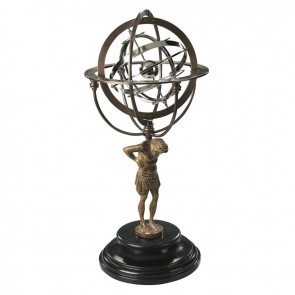
18th Century Atlas armillary
An interesting mix of early science and Greek mythology: One of the legendary Titans battling Zeus was defeated and decreed to carry the weight of the world on his mighty shoulders. Forever. Our armillary dial, however, has Atlas carrying the entire universe. Thatís to say the known Renaissance universe, when the earth was still believed to be at its center. Gracefully intertwined silver rings symbolize the position and trajectories of heavenly bodies around the earth. In all aspects ethereal, science combined with beauty, myth with historic fact. Learn More$525.00 -

Bronze Armillary Dial
Early man, looking at the heavens, believed the stars were fixed to the inside surface of a rotating sphere. Copernicus gave his name to the theory of an Earth-centered universe, and the Vatican propagated his belief by threatening to burn science heretics at the stake for stating otherwise. We now know that we live on the fringe of a nearly infinite and ever expanding universe. Armillary dials have the earth positioned inside a mesh of bronze hoops, symbolizing the course of the planets as known at the time. The course of the sun is shown by a wide band called the ecliptic circle. Learn More$250.00 -

Indianapolis, Alu - Brown
Technically skilled enthusiasts of the 1930s loved to race the legendary B.B. Korn cars around the club tracks. Called tether cars or spindizzies, they reached incredible speeds, and inspired thousands to improve and invent. The founder of the B.B. Korn Manufacturing Company, Barney Korn, produced several tether car models that now, as vintage antiques, achieve astounding sums at auction. For the children of his clients Mr. Korn designed and built "The Indianapolis," a non-powered pre-war giveaway. It was meant to enthuse children and get them to participate in motoring activities. Our Indy ëtoyí car pays homage to Kornís legacy with detailed dash, rubber tires, and hand-polished aluminum body. Learn More$125.00 -

Bantam Midget
The 1930s saw the rise of hand built model racecars, known as spindizzies or tether cars. Miniature racecars built by hobbyists zoomed around banked wooden tracks at speeds approaching 150 miles per hour. Resembling the full-size racers of their day, several spindizzies competed at once, tethered by cables to a central pole. Powered by model airplane engines, spindizzies raced against the clock. Incredibly detailed and aerodynamic, these miniature racecars were beyond toys: they were pieces of art representative of the best pioneering technology of the era.†Constructed using original blueprints our Bantam Midget model resembles the original down to the smallest detail. One look and youíll be ready to join the competition. Learn More$125.00 -

Venitian Tic-Tac-Toe Game
Bring out the Burgundy, light a pipe, and set the game board. A beautiful table is not available when youíre on safari. Folding Mombasa chairs and a campaign box will have to do: after all your camping out in the Serengeti. Glints of exquisitely varnished cherry, matching aged bronze. Hand blown oversized marbles in white and black complete the palette. Independently beautiful, it pays off to take things along. Learn More -

Solitaire Game
The game of Solitaire is reputed to have been invented by a nobleman confined in the Bastille prison during the early years of the French Revolution. The game is played with 36 marbles. The object is to eliminate all but one marble, which should ideally end up in the center of the game board. Solitaire Di VeneziaÖindividually hand blown glass marbles, full of color, against a solid ebony board. Art in itself, functional and fun as solitaire. Learn More -

Collectors Compass
Its origin was from ancient China. Considered an instrument of magic by many, it was used primarily for Feng Shui purposes. Taken to the West it introduced open-sea navigation. Sailing vessels no longer needed to hug the coast. Learn More$115.00 -

Bronzed 30 minute hourglass on stand
Collectable because of their combined historical and practical value. Some glasses measured up to two hours, used at a time when church pews were designed by the Inquisition to torture the human back. Shipís hourglasses were calibrated to the half hours of the shipís watch, and if the helmsman didnít turn the glass too early it actually doubled in defining longitude. Navigators tried to keep count of the hours: the galleons wrecked on the Western Australian reefs remind us of the perils of incorrectly kept time. To appreciate the important symbolism of the hourglass observe, Renaissance painted still lives, also called Vanitas, filled with symbolism and morals. They very often depict hourglasses. Learn More$135.00 -

Bombay Box
The Camel Fair is held next to the temple of Savitri in Pushkar, Rajasthan. Once a year over 80,000 camels, cows, sheep, goats, and horses, some 200,000 merchants, farmers, bandits, thieves, and a variety of human existence gather to find enlightenment and-or commerce. This is where Mary and John Newby from Arkaroola (N.S.Wales) went every year in the Twenties to select camel breeding stock for the Australian outback. Bringing along a stock of fine wines like Ch‚teau Soutard and bottles of Vieille Reserve Armagnac 1883 to survive hardship, they strapped campaign boxes onto their Bentleys and headed to the desert for a week or so to live in tents. Learn More$595.00
Shop By
Currently Shopping by:
- Category: Accessories Remove This Item
Shopping Options
- Category
-
- Bowls (15)
- Boxes (8)
- Candleholders (5)
- Decorative Objects (28)
- Frames (10)
- Pillows (7)
- Trays (12)
- Vases (6)
Community Poll



 simple inc.